
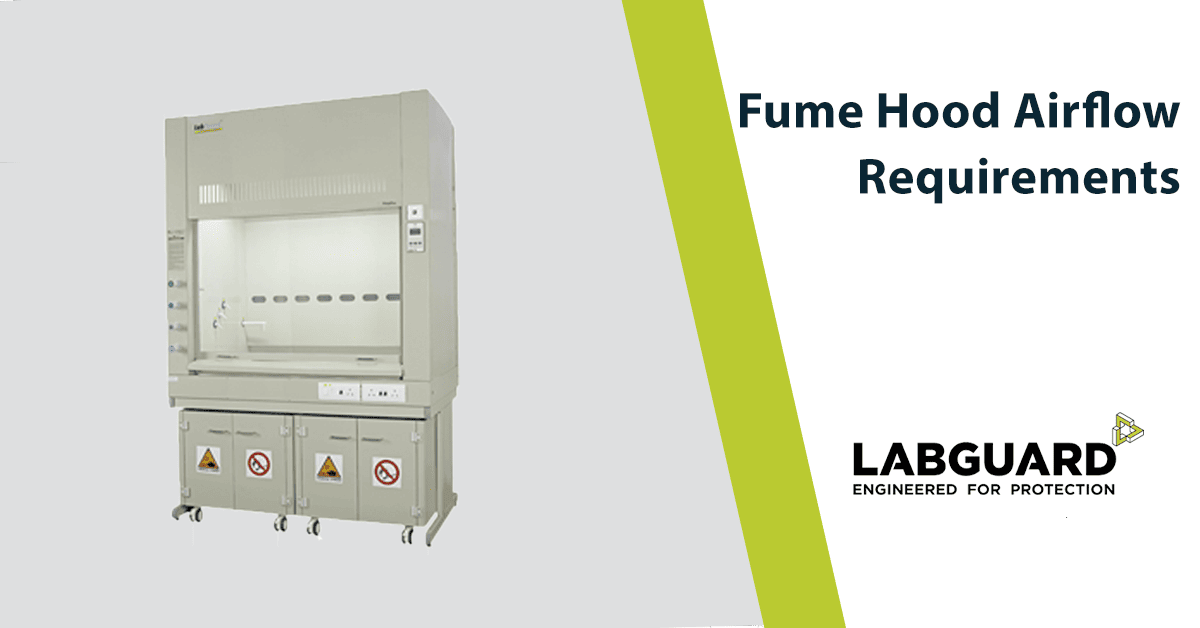
Why Airflow Is Critical for Fume Hood Performance
A fume hood is not just a piece of lab furniture — it’s air-handling safety equipment designed to protect researchers by removing and containing airborne contaminants.
Proper fume hood airflow ensures that harmful vapors and gases are safely exhausted from the lab environment. Inadequate or imbalanced airflow can lead to poor containment, contamination risks, and unsafe working conditions.
How Fume Hood Airflow Works
The fume hood operates through an exhaust blower that pulls air from the lab into and through the hood. This process captures and expels chemical fumes through an exhaust duct or filtration system.
The air volume passing through a fume hood depends on two key factors:
- Sash opening area (sq. ft.)
- Average face velocity (feet per minute or fpm)
For example:
If the required face velocity is 100 fpm and the sash opening area is 7.5 sq. ft.,
then the air handling volume = 7.5 × 100 = 750 CFM (cubic feet per minute).
This applies to a Constant Air Volume (CAV) fume hood. In contrast, a Variable Air Volume (VAV) fume hood adjusts airflow automatically based on sash position, maintaining safety while conserving energy. In VAV hoods, the exhaust airflow drops significantly when the sash is closed.
Balancing Supply and Exhaust Air in Laboratories
A fume hood doesn’t work in isolation — it depends on the overall laboratory ventilation design.
Slight Negative Pressure: The lab should always maintain slightly less incoming air than exhaust air to prevent contaminants from escaping into adjacent areas.
Positive Pressure: If incoming air exceeds exhaust air, contaminants may remain trapped inside the room.
Insufficient Supply Air: If the air supply is too low, the hood will “starve” of air, reducing containment efficiency.
Maintaining this airflow balance is the foundation of safe and effective lab ventilation design.
Key Standards Governing Fume Hood Airflow
- ASHRAE 110:2016 – Performance testing of laboratory fume hoods
- EN 14175 – European standard for fume hood containment and airflow performance
- SEFA – Construction and safety standards for lab equipment
These standards ensure that fume hoods deliver consistent containment and user protection under real operating conditions.
Best Practices for Smooth, Laminar Airflow
Avoid Turbulence Around the Fume Hood
- Keep air vents, fans, or doors away from the hood’s front face.
- Minimize unnecessary movement of people and materials near the hood.
- Avoid placing obstructions in front of the sash.
Even small disturbances can significantly affect airflow stability and containment efficiency.
Inside the Hood
- Position apparatus at least six inches behind the airfoil.
- Keep the rear baffle area clear of blockages.
- Limit heat-generating equipment inside the hood to prevent air disruption.
- Maintain a clean and uncluttered work area for laminar airflow.
Monitoring Airflow and Ensuring Compliance
Modern fume hoods are equipped with Airflow Monitors (AFMs) that continuously track and display face velocity.
These monitors indicate whether the airflow is within a safe or unsafe range — they must never be bypassed or tampered with.
Regular fume hood testing, calibration, and certification are essential to ensure continued compliance with safety standards.
Routine checks should include:
- Airflow velocity audits
- Face velocity calibration
- Filter and duct inspections
- System balancing for supply and exhaust
Training and Safe Operating Practices
User behavior plays a vital role in maintaining fume hood efficiency. Lab personnel must be trained in proper sash operation and airflow awareness.
Prohibited Practices:
- Keeping the sash open when the hood is idle
- Placing the head inside the hood while working
- Checking airflow with a paper strip or hand movement
Proper training ensures that the fume hood performs as designed and continues to protect its users effectively.
Modern Tools for Airflow Optimization
Advancements in laboratory airflow engineering and computational fluid dynamics (CFD) now allow engineers to simulate and optimize hood performance even before installation. Advanced technologies like Aeroguard Dynamics Airflow and Vortex Containment Systems enable even CAV fume hoods to provide energy-saving benefits similar to VAV systems.
These technologies help design systems that are:
- Safe and Robust
- Comfortable for users
- Energy-efficient
Combined with SmartSash™ and Ecoflow VAV controls, modern hoods can significantly reduce HVAC energy consumption while maintaining superior containment.
Choosing the Right Fume Hood for Your Application
While standard sizes and configurations exist, every lab’s airflow requirement is unique.
Competent manufacturers like LabGuard can design and deliver bespoke fume hoods — customized for specific applications, chemical loads, and space constraints.
For specialized needs such as acid digestion, radioisotope handling, or ductless filtration, dedicated ventilated enclosures and application-specific fume hoods are available.
Key Takeaway: Airflow Equals Safety
Proper fume hood airflow design is the single most critical factor in laboratory safety.
By understanding and maintaining airflow requirements, labs can ensure:
- Consistent containment performance
- Regulatory compliance
- Long-term equipment durability
- Safe and Robust performance
When in doubt, consult your fume hood manufacturer or HVAC engineer to assess airflow requirements and system compatibility.
It must be noted that given above are external dimensions and that the internal dimensions differ among manufacturers. Users must evaluate the internal useable area in consultation with manufacturers. Ducted fume hoods are re-locatable to an extent but not portable.
Finally, standard sizes need not be a limiting factor in procuring the right fume hood for a certain application. Competent manufacturers have the expertise to design and deliver bespoke (suit to use) fume hoods. Beyond fume hoods, there are special-purpose ventilated fume enclosures for odd needs. The need for fume ventilation must be technically assessed and the correct solution must be used. One should remember that the single most important aspect is always user safety.
