
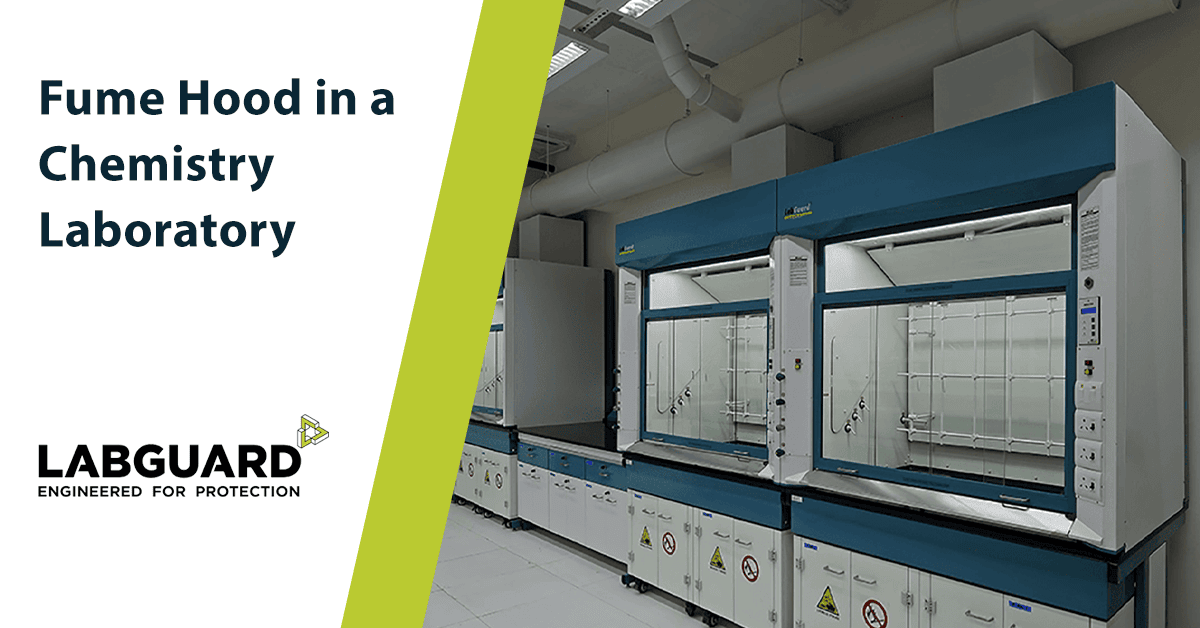
Understanding the Role of a Fume Hood in Chemistry Labs
A fume hood is one of the most critical pieces of equipment in a chemistry laboratory. It serves a dual purpose — as a facilitation tool that enables complex experiments and as a safety device that protects researchers from hazardous exposure.
While most users recognize the functional aspect, it’s equally important to understand its vital role in ensuring laboratory safety.
Why Fume Hood Safety Matters
Experiments in chemistry labs often involve volatile, reactive, or toxic chemicals. Even trace exposure can pose health risks.
Major Hazards Prevented by Fume Hoods
- Inhalation of vapors and gases: Chemical fumes can directly enter the bloodstream.
- Particulate exposure: Tiny particles can settle deep within the lungs (Alveolar Region).
- Toxic odors: Strong odors or vapors can cause nausea, dizziness, or other health effects.
A properly designed and installed fume hood significantly reduces user exposure to hazardous gases, fumes, vapors, and odors by continuously drawing contaminated air away from the breathing zone.
How a Fume Hood Works
A fume hood confines and exhausts airborne contaminants.
It works by:
- Drawing in laboratory room air through the front opening.
- Diluting hazardous vapors with a high airflow volume.
- Expelling contaminated air safely through an exhaust system.
This mechanism not only protects users but also prevents cross-contamination within the lab environment.
In case of spills, splashes, or small explosions, the fume hood enclosure acts as a physical barrier, ensuring user safety.
Types of Fume Hoods Used in Chemistry Laboratories
1. Bench-Top Fume Hood
Used for standard experimental setups at working height. Ideal for general chemistry operations and academic labs.
2. Low-Bench Fume Hood
Designed for taller apparatus or distillation setups, offering additional vertical workspace.
3. Walk-In Fume Hood
Suitable for large or mobile equipment, allowing experiments that require rolling heavy setups in and out.
Ducted vs. Ductless Fume Hoods
Ducted Fume Hoods
- Contaminated air is vented outside the building via ductwork.
- Best suited for high-volume or mixed-chemical applications.
- Require integration with the building’s HVAC system.
Ductless (Recirculating) Fume Hoods
- Contaminated air is filtered through activated carbon or chemically treated filters before being released back into the lab.
- Ideal for specific, low-to-moderate hazard applications.
- Require proper filter selection and maintenance to remain effective.
Modern ductless fume hoods, such as LabGuard’s EKá Green, offer eco-friendly filtration for labs without duct infrastructure.
Specialized Fume Hoods for Chemistry Applications
Different chemicals demand application-specific fume hood designs:
- Radioisotope Fume Hoods: For handling radioactive materials with shielding and easy decontamination.
- Perchloric Acid Fume Hoods: Equipped with integrated wash-down systems to prevent crystal formation.
- Polypropylene (Polypro) Fume Hoods: Built for strong acids such as HF, Aqua Regia, and Nitric Acid, offering complete corrosion resistance.
Integrated Utilities and Modern Features
Contemporary fume hoods combine safety with convenience. They can include:
- Chemical storage cabinets beneath the worktop, ventilated with the same exhaust system.
- Integrated gas, vacuum, and water lines, plus electrical outlets and lighting.
- Smart airflow monitors displaying real-time face velocity and alarm indicators.
- Connectivity with Building Management Systems (BMS) for automated airflow control and energy optimization.
Modern designs also allow integration with data logging systems for performance tracking and compliance documentation.
User Awareness: Dos and Don’ts for Safe Operation
Always
- Keep the sash at recommended height during use.
- Place apparatus at least six inches inside the hood.
- Ensure airflow monitors display “safe” before beginning work.
- Maintain clean, clutter-free surfaces for laminar airflow.
Never
- Put your head inside the fume hood.
- Leave the sash open when not in use.
- Block airflow vents or baffles.
- Test airflow using a paper strip or hand movement.
Maintenance, Audits, and Training
Regular maintenance and testing are essential to ensure the fume hood performs as intended.
Laboratories should schedule:
- Quarterly airflow audits
- Annual ASHRAE 110 performance tests
- Calibration of airflow monitors
- User refresher training sessions
These steps ensure the equipment remains compliant and reliable, minimizing exposure risks and supporting safe lab operations.
The Evolution of Fume Hood Technology
Modern fume hood engineering is more advanced than ever.
Technologies such as Computational Fluid Dynamics (CFD) are used to optimize airflow design before fabrication, ensuring high containment with low energy use.
With innovations like SmartSash™ systems, VAV airflow controls, and integrated sensors, today’s fume hoods deliver:
- Greater safety
- Improved comfort
- Reduced HVAC energy consumption
Key Takeaway: Safety First, Always
A fume hood is often described as the lungs of a laboratory — it breathes out contaminants, keeping the environment safe and the researchers healthy.
For optimal performance:
- Follow operating SOPs.
- Conduct regular maintenance.
- Prioritize user training.
A well-maintained fume hood not only enables better science but also ensures that every researcher returns home safely at the end of the day.
