
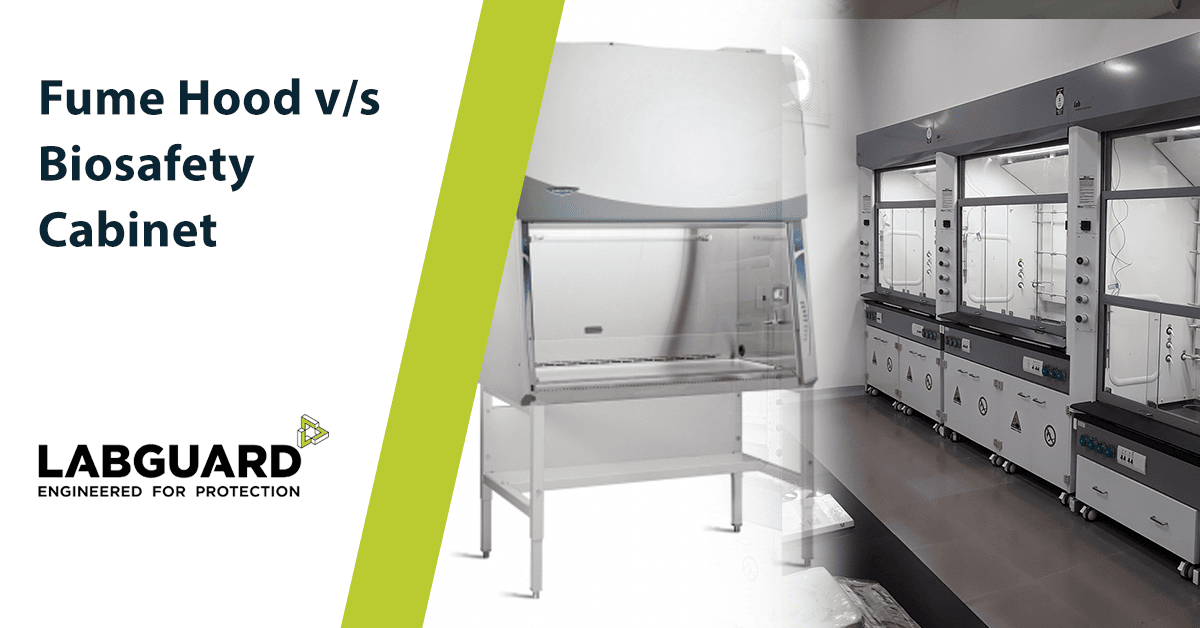
In these challenging times that the world is facing, it is very important to know about the safety devices that we use in our laboratories. Fume Hoods and Bio Safety Cabinets are two such equipment that we often use. Both are essentially ventilated hoods, which keep the Scientist safe from hazards. Their use, therefore, could be mistakenly assumed. Given below are the main differences between the two:
| Feature | Fume Hood | Bio-Safety Cabinet |
| Offers protection from | Contaminants of Chemical nature | Contaminants of Biological nature |
| Used for hazard type | Chemicals: Odorous, Toxic, Reactive, Aerosols Spattering, Gaseous, Carcinogens, and Volatile materials | Biologicals:
Infectious Micro-organisms, Hazardous Powders (Particulates) |
| Method | Contaminated room air is led away from the user into the ducted fume hood, which safely contains it and exhausts to the outside environment. In ductless fume hoods, contaminated air is filtered and recirculated into the same room. | Prevent Biological Contamination of the sample or/and protect the user from getting infected/ affected. No contaminant is released unless filtered through HEPA. Filtered air is released in the same room or is exhausted outside. |
| Operates Under | Negative Pressure only | Negative or Positive Pressure |
| Filtration used | None in Ducted Fume Hoods, Activated Carbon in Ductless Fume Hoods | HEPA Filter in all types of Bio-Safety Cabinets |
| International Standards | ANSI/ASHRAE 110:1995,
EN14175 | NSF/ANSI 49
EN 12469 |
| Recommended | Must Wear |
Thus, the two pieces of equipment offer only specific protection, for which they are designed. A user must be clear about the selection of the right equipment for a particular experiment. Users must be aware of the SOPs, safe working practices, and limitations while using any of this equipment. Regular training and safety program must be conducted by the facility management.
