
India’s laboratory ecosystem is changing in ways that are easy to miss if you only look at surface-level indicators.
What is happening today is not a single disruption, but a steady re-engineering of how labs are planned, funded, built, validated, and operated. CRO expansion, faster pharma R&D cycles, specialty chemical growth, diagnostics scale-up, and tightening regulatory scrutiny are all pushing laboratories toward higher standards.
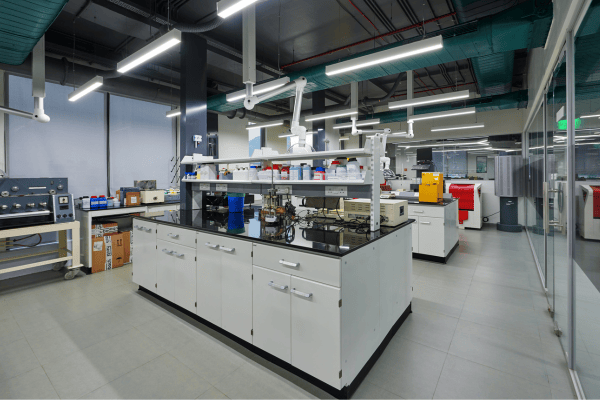
By 2026, Indian labs are moving away from fragmented, utility-driven spaces. They are becoming integrated, validated, modular, automated, and compliance-ready environments.
CAPEX and OPEX thinking is being rebalanced
Laboratory investments are no longer viewed only through a capital-heavy lens.
Organizations are increasingly reserving CAPEX for infrastructure that has a long operational life. Furniture systems, ventilation, fume hoods, and core utilities still justify upfront investment. At the same time, many analytical, routine QC, stability, and development activities are shifting toward OPEX-led models.
Shared R&D facilities, outsourced testing, and innovation hubs are reducing the cost per lab while allowing faster scale-up. For CROs and pharma companies, this shift lowers risk and improves flexibility without compromising capability.
Fume hood performance is now questioned, not assumed
The presence of a fume hood is no longer considered proof of safety.
Containment is expected to be demonstrated through data. Low-flow designs, aerodynamic airflow control, auto-sash mechanisms, and VAV-based ventilation are becoming standard expectations. Application-specific hoods for corrosive digestion, perchloric use, radioisotopes, and similar risks are seeing wider adoption.
Safety conversations have moved away from installation checklists toward performance validation and documented outcomes.
ASHRAE 110 testing is becoming a procurement requirement
Procurement expectations have changed noticeably.
Buyers now ask for tracer gas testing, face velocity mapping, cross-draft analysis, VAV response verification, and post-installation validation reports. These are no longer differentiators. They are baseline requirements driven by global audits, evolving GMP norms, and higher safety accountability.
In many tenders, ASHRAE 110 compliance is treated as mandatory rather than optional.
GI furniture is replacing CRCA across most lab categories
A clear material transition is underway.
Galvanized iron furniture is increasingly preferred over CRCA because it offers better corrosion resistance, higher load capacity, longer structural stability, and lower lifecycle maintenance. In chemical-intensive environments and coastal regions, the durability advantage is especially clear.
As a result, GI furniture has become common across CROs, pharma R&D, QC labs, and academic research facilities.
Modularity has become a design expectation
Modern labs are designed with change in mind.
C-frame and H-frame systems, mobile islands, suspended storage, vertical space utilization, and plug-and-play service panels are now common. These features allow labs to reconfigure quickly as workflows evolve.
Modularity reduces downtime, simplifies expansion, and improves long-term safety by avoiding ad hoc modifications.
Ergonomics is now treated as a productivity and safety factor
Long working hours and skilled manpower challenges have brought ergonomics into sharper focus.
Height-adjustable benches, improved seating, anti-fatigue flooring, better task lighting, and noise control are no longer seen as optional comforts. They are increasingly linked to productivity, error reduction, and workforce retention.
Labs that ignore ergonomics often see higher fatigue-related issues over time.
Digital and IoT adoption is accelerating across labs
Digitization is no longer driven by curiosity or innovation alone. It is driven by compliance and traceability.
Labs are adopting IoT sensors for airflow, pressure, temperature, and humidity. Smart fume hoods provide real-time performance data. Cloud-based LIMS platforms, electronic lab notebooks, predictive maintenance tools, and RFID-based asset tracking are becoming common.
Digital systems are now viewed as essential infrastructure rather than add-ons.
Compliance is being designed in from the start
Regulatory expectations have increased significantly.
Instead of retrofitting safety and compliance later, labs are now designed with pressure zoning, hazardous area segregation, validated ventilation strategies, compliant chemical storage, and documented safety logic from day one.
Frameworks such as revised Schedule M, NABL 17025, GLP, ISO standards, NFPA fire safety, and ASHRAE ventilation principles are shaping layouts early in the design phase.
Sustainability is becoming a measurable performance metric
Energy costs and ESG commitments are influencing lab design decisions.
VAV-based ventilation, low-flow fume hoods, LED and motion-based lighting, heat recovery systems, solar integration, and long-life GI furniture are increasingly part of ROI discussions. Sustainability is no longer treated as a branding exercise. It is evaluated as an operational and financial advantage.
Growth of highly specialized laboratories continues
India is building more application-specific labs than ever before.
Extractables and leachables labs, genomics facilities, cell culture suites, bioassay labs, radioisotope facilities, nano-material labs, ADME and DMPK units, and environmental testing labs all require customized infrastructure.
These labs demand tailored ventilation, zoning, fire safety strategies, and furniture systems that generic layouts cannot support.
Automation is becoming standard across lab operations
Automation is no longer restricted to advanced or premium labs.
Sample tracking, barcoding, workflow routing, autosamplers, robotic pipetting, automated digestion, real-time alerts, BMS integration, and intelligent report generation are becoming common. Automation helps address skill shortages, improves reproducibility, and strengthens audit readiness.
Where India still has room to evolve
Despite rapid progress, certain global practices are not yet widely adopted.
Fully autonomous robotic labs, digital twins for lab design, formal green lab certifications, large-scale ductless hood ecosystems, unified digital backbones, and AI-driven inventory forecasting are still limited in India. These areas represent the next phase of evolution, likely to accelerate between 2027 and 2030.
Why turnkey lab delivery is becoming the default
As laboratories become more complex, fragmented execution models are proving difficult to manage.
Organizations increasingly prefer turnkey partners who can integrate lab design, HVAC, furniture, fume hoods, utilities, validation, and documentation under one scope. This approach reduces coordination risk, shortens execution timelines, limits change orders, and enables cleaner compliance handovers.
Vendor evaluation has also become more structured, with clearer expectations around testing capability, documentation quality, service support, and lifecycle accountability.
Closing perspective
By 2026, Indian laboratories are entering a distinctly higher-performance phase.
They are safer, more modular, more compliant, more automated, more energy-efficient, and more digitally connected than ever before. The change is not dramatic on the surface, but it is deep and structural.
India is closing long-standing gaps with global lab ecosystems. In many areas, it is setting the pace for how emerging markets modernize scientific infrastructure.