
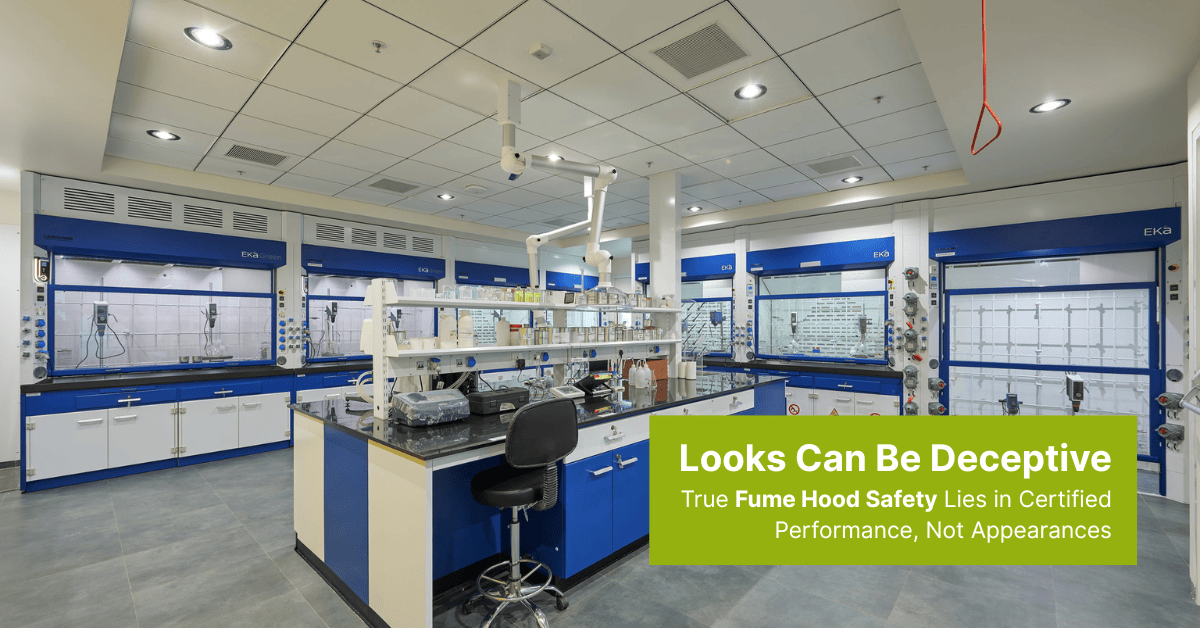
You’ve likely heard this before in lab procurement conversations:
“It looks just like an ASHRAE 110 tested fume hood. And it’s cheaper.”
On the surface, it might sound like a smart buy. But to those of us who’ve spent decades designing and installing lab ventilation systems, this phrase is deeply concerning—and dangerously misleading.
Let us say this clearly:
Visual similarity does not equal performance.
And when it comes to fume hoods, performance is everything.
Fume Hoods: More Than Metal Boxes
Fume hoods aren’t just metal enclosures with a glass sash and an exhaust fan. They are critical safety devices designed to protect researchers from hazardous vapors and chemical exposure. A single design flaw—whether in the baffle geometry, airfoil angle, or even side post configuration—can cause invisible containment failures that slowly expose users to toxic fumes over time.
This isn’t theoretical. It’s backed by data.
A study published in the AIHA Journal (American Industrial Hygiene Association) found that nearly 20% of fume hoods in the USA failed containment tests—often due to poor design or improper maintenance.
And in India, the failure rate is likely much higher. The lack of regulation enforcement, coupled with the presence of numerous untested, unverified fume hood manufacturers, makes it easy for underperforming products to enter labs—sometimes with disastrous consequences.
The Certification Myth: Don’t Fall for the Fine Print
Many procurement teams rely on a simple brochure statement like “complies with ASHRAE 110” without asking the critical questions:
- Is the fume hood model actually tested under ASHRAE 110 or EN 14175 protocols?
- Was the test conducted by a recognized third-party lab?
- Can the manufacturer provide a model-specific test report?
- Have you seen a live tracer gas containment test on the actual product?
In too many cases, the answers are vague or unavailable. Yet, labs go ahead and purchase hoods based solely on cost or appearance—unknowingly compromising the safety of their users.
Would You Install a Fire System Without Certification?
Think about it.
Would you ever install a fire suppression system without a valid test certificate?
Would you allow your team to wear PPE that was never third-party tested?
Then why make an exception for your fume hood, which is literally your first line of defense against chemical exposure?
What You Must Ask For — Especially in India
Procurement teams, facility managers, and lab designers must take the lead in setting higher benchmarks. Here’s what must be non-negotiable when purchasing fume hoods in India (or anywhere):
- ASHRAE 110:2016 or EN 14175 test report issued by a third-party testing facility for the specific model you are buying
- Live containment test demonstration at the manufacturer’s test lab
- Tracer gas containment testing for real-world performance validation
- Clarity on who issued the certificate, with traceable lab credentials
This Isn’t About Price — It’s About Users
At the end of the day, the fume hood isn’t just a product. It’s a promise—that the person working behind that sash is safe, even while handling the most hazardous substances.
In science, trust is built not just on data—but on discipline. Let’s raise the bar. For our researchers. For our labs. And for the future of safe science.
About LabGuard
LabGuard is one of India’s leading manufacturers of certified fume hoods and laboratory furniture, with a strong commitment to international safety standards like ASHRAE 110 and EN 14175. We invite you to visit our in-house test lab and experience live containment demonstrations to see the difference for yourself.
